
 WhatsApp Quick Enquiry
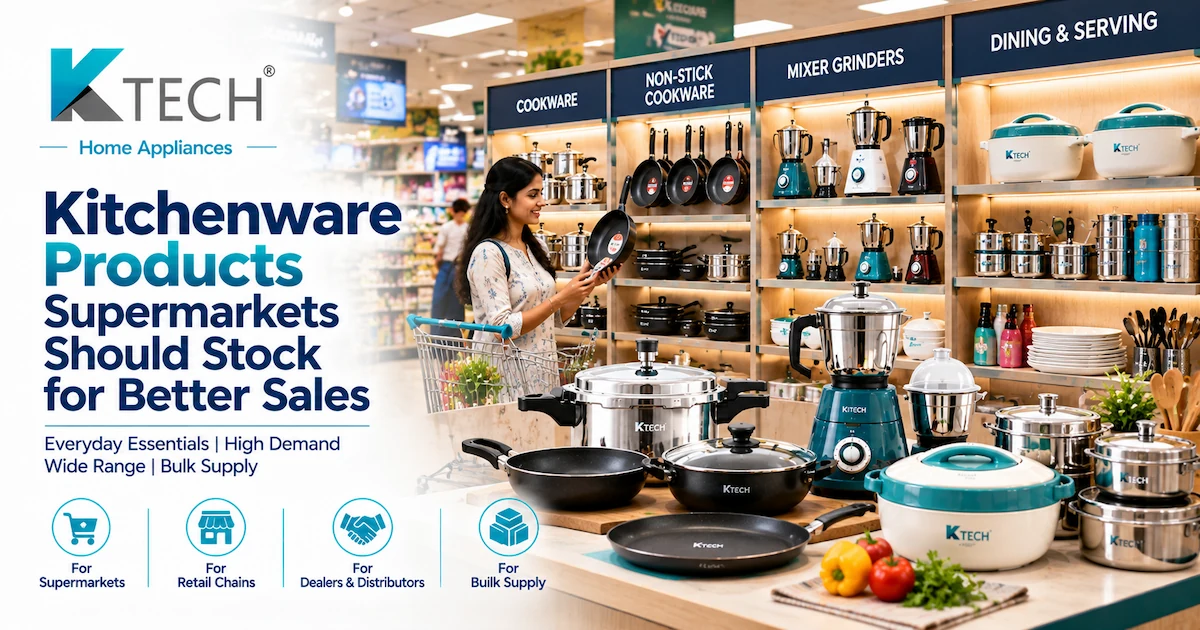
Kitchenware Products Supermarkets Should Stock for Better Sales
By Ktech Admin - 21/Oct/2026 - 0 comments
A supermarket kitchenware section works best when customers can quickly find products they already use at home, along with a few additional options that make cooking and serving easier.
The challenge for a retail buyer is not simply deciding how many products to place on the shelf. Stocking too many similar items can slow inventory movement, while carrying too few categories can limit customer choice.
The right approach is to build a practical mix of kitchenware products supermarkets should stock based on everyday cooking habits, household requirements, available shelf space and actual store-level sales.
KTech's current catalogue includes cookware, non-stick cookware, mixer grinders, LPG gas stoves, dining and serving products, electronic appliances, Value Series products, dinner sets, drinkware and other household categories used by supermarkets, retailers and bulk buyers.
Start With Products Customers Understand Easily
Supermarket shoppers usually make faster buying decisions when the product has a clear everyday purpose.
A pressure cooker, dosa tawa or casserole does not require a lengthy explanation. Customers already understand where these products fit into the kitchen.
This makes practical kitchenware a useful category for supermarkets because it can serve:
- Families replacing old kitchen products
- Customers setting up a new home
- Buyers looking for additional cookware
- Festival and gifting shoppers
- Budget-conscious households
- Customers making convenient add-on purchases
Retailers should therefore prioritise familiar, useful categories before expanding into highly specialised products.
Kitchenware Categories Supermarkets Can Consider
A balanced kitchenware assortment can cover cooking, food preparation, serving and everyday household use.
|
Product Category |
Role in the Supermarket |
Main Buying Consideration |
|
Pressure Cookers & Cookware |
Core everyday cooking |
Capacity, material and household size |
|
Non-Stick Cookware |
Breakfast and regular cooking |
Product type, size and cooking use |
|
Mixer Grinders |
Electrical food preparation |
Motor capacity, jars and price range |
|
Insulated Casseroles |
Dining and serving |
Size, serving need and presentation |
|
Dining & Serving Products |
Household utility |
Daily use and gifting potential |
|
Kitchen Utility Products |
Accessible add-on purchases |
Practical use, price and shelf space |
Pressure Cookers and Everyday Cookware
Cookware should usually form one of the stronger sections in a supermarket kitchenware aisle.
Customers regularly need products for boiling, frying, steaming, rice preparation, curries and other daily meals.
The KTech Cookware category currently includes pressure cookers, aluminium cookers, stainless-steel cookware, induction-base cookware and other essential cooking vessels. The category is positioned for households, supermarkets, retail stores and bulk kitchenware supply.
A supermarket can create a more useful range by including:
- Smaller capacities for individuals and couples
- Medium sizes for regular families
- Larger options for bigger households
- Stainless-steel cookware
- Aluminium cookers
- Selected induction-compatible products
The aim is not to stock every size in equal quantity. Retailers should identify which capacities move consistently and give those products greater shelf depth.
Non-Stick Cookware for Regular Indian Cooking
Non-stick cookware is another practical category because different products serve clearly recognisable cooking needs.
KTech's current Non-Stick Cookware range includes pans, pots, kadais and tawas for dishes such as dosa, chapati, roti, omelette, stir-fry items, snacks and regular family meals.
Useful supermarket options can include:
- Dosa tawas
- Fry pans
- Kadais
- Paniyaram pans
- Appachatty
- Biryani pots
- Gravy pots
For example, KTech currently lists dedicated non-stick pans, pots and kadais, as well as tawa products, making it possible for retailers to arrange the category by cooking purpose rather than displaying everything together.
A well-organised display can also help customers understand the difference between products without needing constant staff assistance.
Mixer Grinders for a Higher-Value Appliance Section
Kitchenware does not need to be limited to cookware.
Mixer grinders can give the supermarket a higher-value electrical appliance category while still staying closely connected to everyday kitchen use.
Customers may use mixer grinders for:
- Chutney preparation
- Wet grinding
- Dry grinding
- Masala preparation
- Coconut grinding
- Blending
- Batter-related preparation
The KTech Mixer & Grinders category currently includes multiple models and jar combinations for homes, supermarkets, appliance dealers and bulk buyers.
Retailers should avoid carrying too many models with nearly identical specifications. A clearer strategy is to provide a few distinct choices across entry-level, regular-use and higher-capacity requirements.
That makes comparison easier for shoppers and reduces unnecessary duplication on the shelf.
Insulated Casseroles for Dining and Serving
Insulated casseroles can fit both everyday household requirements and gifting purchases.
Families may use smaller capacities for rice, rotis, curries and regular serving, while larger sizes can appeal to customers planning functions, catering or group meals.
The KTech Insulated Stainless Steel Casseroles range currently includes different capacities and multi-piece sets, with products aimed at home dining, retail stores, supermarkets, hospitality businesses and bulk buyers.
Supermarkets can consider placing casseroles near:
- Dining and serving products
- Cookware
- Gift sections
- Festival displays
- Housewarming gift sections
The same product may therefore appeal to both household and gifting customers.
Add Everyday Kitchen Utility Products
Not every supermarket customer is looking for a large appliance.
Smaller kitchen and household utilities can help provide more accessible purchase options.
KTech's current Essential Line under its Value Series includes casseroles, kitchenware, utensils, storage products, serving items and daily-use kitchen accessories for homes, supermarkets, retail stores and bulk supply.
These types of products can be useful for filling gaps between major categories.
They may also work well near related sections rather than being grouped into one large miscellaneous display.
For example, serving products can be positioned near dining products, while smaller cooking utilities can sit alongside cookware.
Build the Range Around Different Price Points
A supermarket should not assume that every shopper has the same budget.
A healthier retail assortment usually provides choices across different spending levels.
You can think of the range in three broad groups:
Entry-Level Products
Simple everyday utilities and smaller kitchenware products that customers can purchase without a major buying decision.
Mid-Range Products
Frequently used cookware, non-stick products, casseroles and other items that balance functionality and household value.
Higher-Value Products
Mixer grinders, larger cookware sets or selected appliances that require more consideration.
This structure can make the kitchenware section relevant to more customers without filling it with unnecessary variants.
Use Shelf Space According to Product Movement
Shelf space is limited, so every product should earn its place.
Products with regular customer demand can receive more facings or deeper stock, while slower-moving categories can be maintained in smaller quantities.
Useful supermarket data to track includes:
- Units sold per product
- Category-wise monthly movement
- Fast-moving capacities
- Slow-moving models
- Customer requests
- Seasonal sales changes
- Price ranges with stronger demand
- Stock remaining by branch
This allows the buying team to refine the assortment instead of repeating the same purchase quantities every month.
Avoid Overstocking Similar Products
One common retail mistake is carrying too many products that serve almost the same purpose.
For example, stocking a large number of similar fry pans or nearly identical cookware sizes may create the appearance of variety without actually helping the customer.
A better assortment gives shoppers meaningful choices.
That may mean:
- Different capacities
- Different cooking applications
- Different price levels
- Different materials
- Different product formats
The goal is to give the customer a reason to choose between products rather than forcing them to compare several nearly identical options.
Create Cross-Selling Opportunities
Related kitchenware categories can be placed near one another to make shopping more convenient.
For example:
- Pressure cookers near cookware
- Dosa tawas near non-stick pans
- Casseroles near dining products
- Mixer grinders near food-preparation products
- Gift sets near festival or home sections
Cross-merchandising should remain logical. Randomly placing unrelated products together may make the aisle harder to understand.
A useful display should help shoppers discover products they are genuinely likely to use together.
Plan for Festival and Gifting Demand
Kitchenware is not purchased only for personal use.
During Pongal, Diwali, weddings, housewarmings and business gifting periods, supermarkets may see additional interest in cookware sets, casseroles, kitchen combinations and gift-ready household products.
KTech's current catalogue also includes Festival Gift Packs and Combo Gift Sets intended for retail, gifting and business requirements.
Supermarkets can use seasonal end-caps or promotional displays for these categories without changing the entire year-round kitchenware assortment.
Choose Suppliers That Support Repeat Stock Requirements
A good product mix cannot help the store if popular products repeatedly go out of stock.
Retail buyers should therefore evaluate suppliers on more than the opening price.
Consider:
- Product variety
- Clear specifications
- Bulk availability
- Repeat-order support
- Packaging
- Product information
- Seasonal quantity requirements
- Dealer or distributor coordination
KTech's existing retail and wholesale information specifically addresses supermarkets, hypermarkets, retail chains, wholesale dealers, distributors and kitchen-appliance retailers.
Bulk Kitchenware Supply for Supermarkets
Supermarkets planning larger quantities can explore Bulk Gift Solutions, which currently includes bulk home appliance supply, supermarket product sourcing and retail-chain supply among KTech's business offerings.
Businesses sourcing for multiple stores or different Tamil Nadu locations can also review Tamil Nadu Gift Supply, where KTech lists retail and bulk home-appliance supply for supermarkets, retail chains, dealers and wholesale businesses.
These pages are relevant when the requirement goes beyond a normal consumer purchase and involves larger quantities, repeat stock or multiple outlets.
Frequently Asked Questions
Which Kitchenware Products Should a Supermarket Stock First?
Start with widely understood everyday categories such as pressure cookers, cookware, non-stick tawas and pans, casseroles and selected kitchen appliances. Expand the range using actual sales data.
Are Mixer Grinders Suitable for Supermarket Shelves?
Yes, particularly where the store already carries home appliances or household products. Maintain a few clearly differentiated models instead of too many similar options.
How Many Variants Should a Retailer Keep in Each Category?
There is no fixed number. The right quantity depends on shelf space, customer demand, price range and stock movement. Start with a manageable assortment and expand proven sellers.
Are Casseroles Useful for Supermarket Retail?
Yes. They can serve everyday dining, festive purchases and gifting requirements, especially when offered in practical sizes or sets.
How Can Supermarkets Improve Kitchenware Sales?
Focus on relevant products, clear category organisation, appropriate price points, sensible stock quantities and good availability. No product mix guarantees sales, so decisions should be adjusted using actual store performance.
Conclusion
Choosing the right kitchenware products supermarkets should stock is about building a useful assortment rather than simply filling shelves. Pressure cookers, cookware, non-stick products, casseroles, mixer grinders and everyday kitchen utilities can serve different household needs while giving shoppers meaningful choices.
For supermarkets, retail chains and wholesale buyers planning larger requirements, explore Bulk Gift Solutions and Tamil Nadu Gift Supply for KTech's relevant retail, bulk and statewide supply information.
Share your required product categories, approximate quantities and store locations through KTech's WhatsApp Quick Enquiry, or submit a Bulk Enquiry for larger supermarket and retail-chain requirements.
Tags: Kitchenware, Supermarket Supply, Wholesale Kitchenware, Retail Chains, Cookware, Kitchen Appliances, Bulk Supply, KTech Home Appliances