
 WhatsApp Quick Enquiry
Kitchenware Bulk Supply for Supermarkets and Hypermarkets
By Ktech Admin - 11/Nov/2026 - 0 comments
A supermarket kitchenware section needs more than a large number of products. The range has to make sense for everyday shoppers, fit the available shelf space and give the purchasing team a practical way to manage stock across different categories.
For hypermarkets and larger retail chains, the requirement becomes even broader. Buyers may need cookware, non-stick products, mixer grinders, serving items, kitchen utilities and other household products across several stores.
This is why kitchenware bulk supply for supermarkets and hypermarkets should focus on building the right product mix rather than simply buying the highest possible quantity.
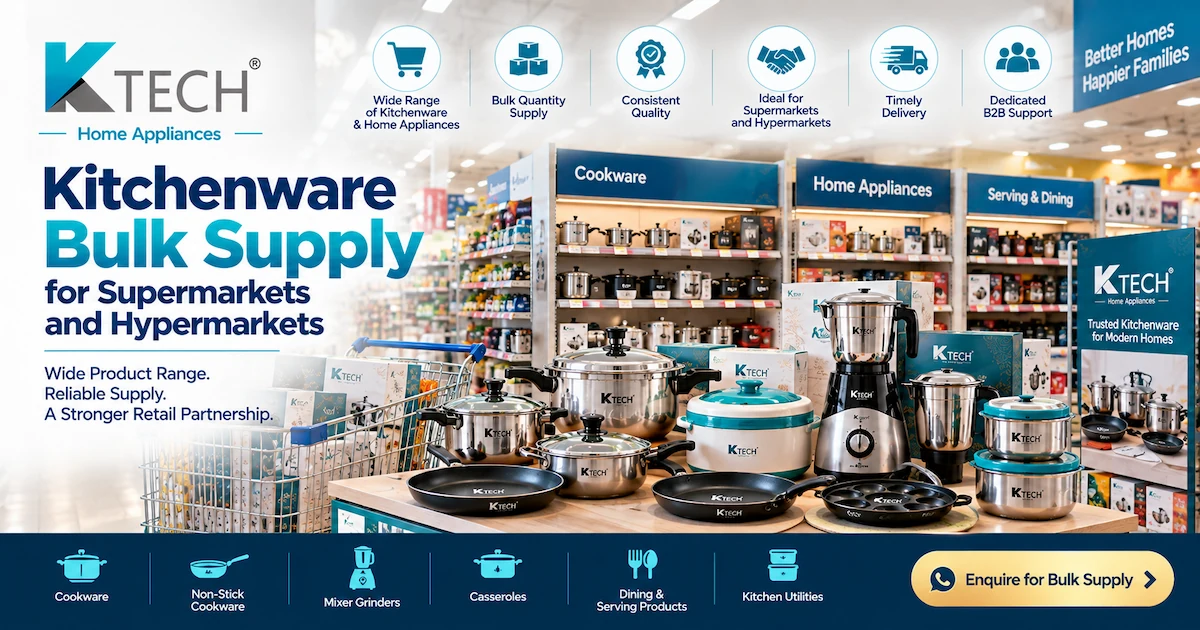
KTech's current catalogue covers cookware, non-stick cookware, mixer grinders, dining and serving products, LPG gas stoves, electronic appliances, drinkware, dinner sets and other household categories used by retail stores, supermarkets and bulk buyers.
What Supermarkets Need From a Kitchenware Supplier
A supermarket does not purchase kitchenware in the same way as a household customer.
A customer may buy one pressure cooker or one tawa. A retail buyer has to decide which categories to stock, how many models to offer and how much inventory each branch requires.
Before selecting a supplier, supermarkets should consider:
- Product-category variety
- Clear specifications
- Different price and usage segments
- Retail-friendly packaging
- Bulk quantity support
- Availability for repeat requirements
- Suitability for different store formats
- Product information for sales teams
The objective is to maintain enough choice for customers without filling shelves with too many similar products.
Build the Product Mix Around Everyday Demand
A practical supermarket assortment usually begins with products customers already understand and use regularly.
Quick Product Mix Guide
|
Product Category |
Role in Retail |
Main Buying Consideration |
|
Pressure Cookers & Cookware |
Core everyday cooking |
Capacity, material and household size |
|
Non-Stick Cookware |
Breakfast and regular cooking |
Product type, size and cooking purpose |
|
Mixer Grinders |
Electrical food preparation |
Motor capacity, jars and price segment |
|
Casseroles & Serving Products |
Dining and food serving |
Capacity, presentation and use |
|
Kitchen Utilities |
Accessible everyday purchases |
Practicality, price and shelf space |
|
Selected Home Appliances |
Higher-value category |
Customer demand, features and display space |
The exact assortment should be adjusted using the store's actual sales movement rather than treating every branch in the same way.
Cookware Should Be a Core Retail Category
Cookware is one of the easiest kitchenware categories for customers to understand because it is connected directly to everyday meal preparation.
KTech's current Cookware range includes pressure cookers, aluminium cookers, stainless-steel cookware, induction-base cookware and other cooking vessels. The company currently positions this category for homes, hotels, restaurants, retail stores, supermarkets and bulk kitchenware requirements.
Retailers can consider a balanced range covering:
- Smaller capacities for individuals and couples
- Medium capacities for everyday family use
- Larger products for bigger households
- Stainless-steel cookware
- Aluminium cookers
- Induction-compatible products where relevant
A useful range should give customers meaningful differences in size, material and use rather than several products that perform almost the same job.
Add Non-Stick Cookware for Regular Cooking
Non-stick products support many common Indian cooking requirements and can therefore complement the main cookware section.
The current KTech Non-Stick Cookware collection includes pans, pots, kadais and tawas. KTech positions these products for households, kitchenware stores, supermarkets, restaurants and bulk cookware buyers.
A supermarket can consider products such as:
- Dosa tawas
- Fry pans
- Kadais
- Paniyaram pans
- Appachatty
- Biryani pots
- Gravy pots
Organising the range according to cooking purpose can also make the shelf easier for customers to understand.
Mixer Grinders Can Add a Higher-Value Category
A supermarket or hypermarket with a home-appliance section may also benefit from carrying selected mixer grinders.
Mixer grinders support common kitchen tasks such as chutney preparation, wet grinding, dry grinding, spice preparation and blending.
KTech's current Mixer & Grinders category includes models across different motor capacities and jar combinations and is positioned for homes, supermarkets, appliance dealers and bulk buyers.
Instead of carrying many nearly identical models, retailers can maintain a smaller range with clear differences, such as:
- Entry-level household option
- Standard everyday-use option
- Higher-capacity option
- Different jar combinations
This gives customers real choices without creating unnecessary inventory duplication.
Include Dining, Serving and Utility Products
Not every kitchenware purchase involves cooking.
Serving, storage and everyday utility products can provide additional options for shoppers who are not currently looking for a large appliance.
KTech's current Essential Line includes casseroles, utensils, kitchenware, food-storage items, serving products and daily-use kitchen accessories for homes, retail stores, supermarkets and bulk supply.
Make KTech Essential Line clickable to the Essential Line category.
These products can be useful for:
- Regular household purchases
- New-home requirements
- Add-on purchases
- Seasonal promotions
- Gifting displays
- Value-focused customers
A supermarket does not need to display every utility product together. Where possible, place products near the category they naturally support.
Avoid Stocking Too Many Similar SKUs
More SKUs do not always mean a stronger retail section.
For example, if a store carries several nearly identical frying pans with only minor differences, customers may find comparison difficult while the retailer has to manage more inventory.
A healthier assortment provides meaningful variation.
That can include differences in:
- Capacity
- Product type
- Cooking application
- Material
- Price level
- Household size
- Features
The customer should be able to understand why one product is different from another.
Use Core, Extended and Test Ranges
One practical way to manage kitchenware across multiple stores is to divide the assortment into three groups.
Core Range
Products that address regular household requirements and should usually remain available.
Examples may include pressure cookers, cookware, tawas, pans and other familiar kitchen essentials.
Extended Range
Additional choices that improve the overall assortment but may not require the same stock depth.
Test Range
New products or less familiar categories introduced in smaller quantities to measure customer interest.
This approach allows supermarkets to expand the range without committing the same inventory level to every product.
Different Stores May Need Different Stock
Even within the same retail chain, different branches may not sell the same kitchenware at the same rate.
A larger hypermarket may be able to support a broader kitchenware and appliance display, while a smaller supermarket may perform better with a more focused everyday range.
Retail teams should review:
- Category-wise sales
- Store-wise stock balance
- Fast-moving products
- Slow-moving SKUs
- Customer enquiries
- Popular capacities
- Price segments
- Seasonal demand
Repeat orders can then be adjusted according to actual movement.
Plan Shelf Space Before Placing the Bulk Order
Kitchenware varies considerably in size.
A pressure cooker, mixer grinder or large casserole needs more display space than a small kitchen utility product.
Before confirming quantities, buyers should consider:
- Shelf dimensions
- Display height
- Product-box size
- Number of facings
- Back-room storage
- Branch capacity
This becomes particularly important when one purchase order is intended for several supermarket locations.
Bulk quantity should therefore be planned together with shelf and storage capacity.
Use Cross-Merchandising Carefully
Products that naturally work together can be placed near one another.
Examples include:
- Pressure cookers near cookware
- Tawass and pans within the non-stick section
- Casseroles near dining and serving products
- Mixer grinders near food-preparation appliances
- Gift packs near seasonal displays
Cross-merchandising should make shopping easier, not create a mixed section where customers cannot understand where products belong.
Prepare for Seasonal Demand
Kitchenware can also become more visible during Pongal, Diwali, wedding seasons, housewarming periods and retail promotional campaigns.
During these periods, supermarkets may consider giving additional display space to:
- Cookware combinations
- Casserole sets
- Kitchen gift sets
- Mixer grinders
- Dining products
- Selected festival packs
However, seasonal demand should not automatically lead to over-ordering.
Review past movement, current inventory and expected promotional activity before increasing quantities.
Packaging and Product Information Matter in Retail
A product may be well suited to the customer but still become difficult to sell if the basic information is unclear.
Retail buyers should ensure that relevant product information is available for store teams and customers.
Depending on the product, useful information may include:
- Capacity
- Product type
- Compatibility
- Included accessories
- Model details
- Basic usage information
This reduces unnecessary confusion during the purchase decision.
Plan Repeat Orders, Not Just the Opening Order
A successful bulk purchase is not only about how much stock enters the store on day one.
Retailers also need to think about what happens when certain products start moving faster than expected.
A practical procurement process should track:
- Current stock
- Units sold
- Branch-wise demand
- Fast-moving products
- Pending replenishment
- Seasonal requirements
This makes repeat purchasing more controlled and helps reduce the risk of both stockouts and unnecessary overstocking.
Choosing a Bulk Supply Partner
Supermarkets and hypermarkets should evaluate the supplier relationship beyond the first quotation.
Useful points to discuss include:
- Required product categories
- Approximate quantity
- Number of retail locations
- Product specifications
- Packaging requirements
- Repeat-order process
- Seasonal requirements
- Delivery locations
KTech already publishes guidance specifically for retail stores, supermarkets and hypermarkets on selecting home-appliance and bulk-supply partners.
The most suitable arrangement will depend on the actual products, quantities and store network.
Kitchenware Bulk Supply for Supermarkets and Hypermarkets
KTech's current website explicitly positions its product ranges for supermarkets, retail chains, dealers, distributors and other bulk buyers. Its retail-focused content includes pressure cookers, cookware, non-stick cookware, mixer grinders, casseroles, drinkware, dinner sets and kitchen combinations among the categories relevant to supermarket and retail supply.
For larger business requirements, Bulk Gift Solutions also contains KTech's dedicated bulk home-appliance supply information for supermarkets, hypermarkets, retail chains, department stores, distributors and wholesale buyers.
Businesses operating across Tamil Nadu can also use Tamil Nadu Gift Supply, which currently includes retail and bulk home-appliance supply information for supermarkets, hypermarkets, retailers, dealers and distributors.
Frequently Asked Questions
What Kitchenware Should Supermarkets Stock First?
Start with products customers already understand and use regularly, such as pressure cookers, cookware, non-stick tawas and pans, casseroles and selected kitchen appliances. Expand the assortment using actual sales data.
Should Hypermarkets Carry More Kitchenware Than Supermarkets?
Not automatically. Larger stores generally have more display capacity, but the range should still depend on customer demand, category performance and available storage.
How Can Retailers Avoid Overstocking Kitchenware?
Start with a practical core assortment, monitor sales by category and SKU, and increase quantities for products that show consistent movement.
Can Supermarkets Buy KTech Kitchenware in Bulk?
KTech currently markets its cookware, non-stick cookware, mixer grinders, utility products and other appliance categories to supermarkets, retailers, dealers and bulk buyers.
What Should Retail Buyers Share When Making a Bulk Enquiry?
It helps to provide the required product categories, approximate quantities, number of stores or delivery locations and any specific product requirements. This allows the enquiry to be discussed more efficiently.
Conclusion
Effective kitchenware bulk supply for supermarkets and hypermarkets starts with the right assortment. Retailers should balance everyday cookware, non-stick products, mixer grinders, serving products and kitchen utilities according to customer demand, shelf space and actual stock movement.
KTech provides multiple kitchenware and home-appliance categories for supermarkets, hypermarkets, retail chains, dealers and wholesale buyers. Businesses planning larger purchases can review Bulk Gift Solutions and Tamil Nadu Gift Supply for relevant bulk and statewide supply information.
Share your required categories, approximate quantities and store locations through KTech's WhatsApp Quick Enquiry, or submit a Bulk Enquiry to discuss larger supermarket, hypermarket or retail-chain supply requirements.
Tags: Bulk Kitchenware, Supermarket Supply, Hypermarkets, Wholesale Kitchenware, Retail Chains, Cookware, Home Appliances, KTech Home Appliances