
 WhatsApp Quick Enquiry
How to Choose Stainless Steel Cookware for Everyday Use
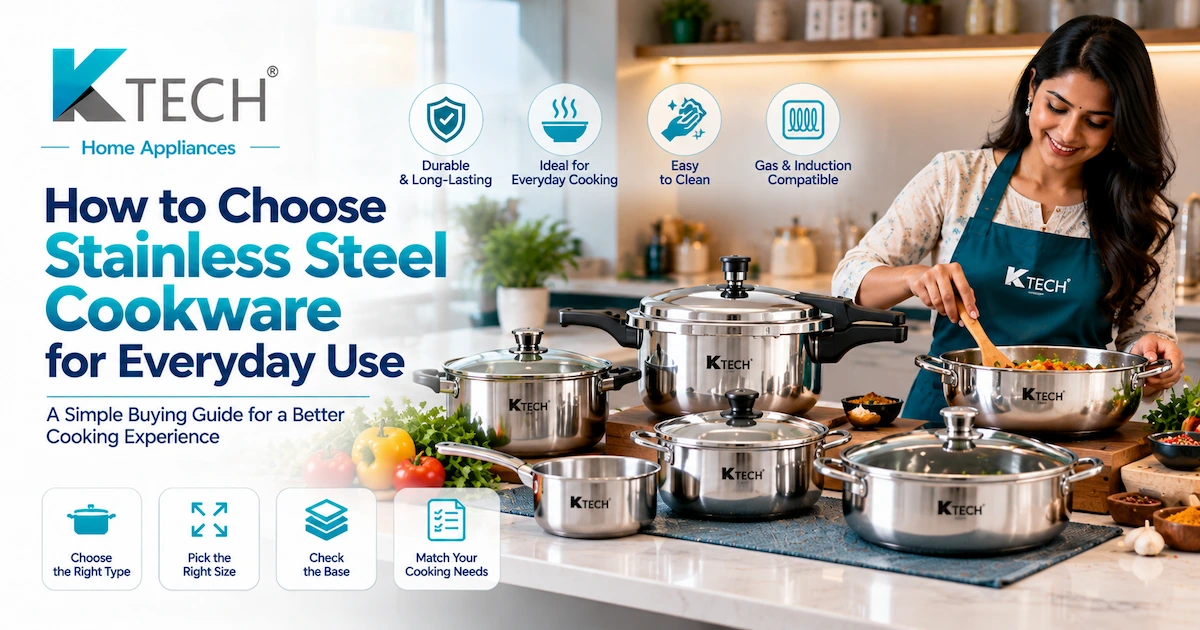
By Ktech Admin - 21/Oct/2026 - 0 comments
Stainless steel cookware is a familiar choice in Indian kitchens because it can handle many everyday tasks, from boiling milk and preparing rice to cooking curries, vegetables and family meals.
But buying stainless steel cookware is not simply about choosing a shiny vessel in the right price range. The shape, capacity, base construction, handle design, lid and cooktop compatibility all affect how comfortable the cookware will be to use every day.
Understanding how to choose stainless steel cookware for everyday use helps you avoid buying pieces that are too large, too small or unsuitable for the dishes you prepare most often.
KTech's current cookware range includes stainless-steel cookware, pressure cookers and other cooking vessels designed for household and regular Indian cooking requirements.
Start With What You Cook Most Often
Before comparing cookware sets, think about your normal weekly cooking routine.
A family that regularly prepares sambar, curry and rice may need different vessels from someone who mainly cooks smaller meals for one or two people.
Consider what you prepare most often:
- Rice and pulao
- Dal and sambar
- Curries and gravies
- Vegetables
- Milk and tea
- Soups
- Frying and sautéing
- Pressure-cooked meals
- Reheating leftovers
You do not necessarily need a large cookware set if only three or four vessels will be used regularly.
Start with the pieces that match your everyday meals.
Choose the Right Type of Stainless Steel Cookware
Different vessel shapes work better for different cooking tasks.
|
Cookware Type |
Suitable For |
What to Check |
|
Cooking Pot |
Rice, boiling, reheating, curries |
Capacity, base and lid |
|
Kadai |
Frying, sautéing, gravies and curries |
Depth, handles and base stability |
|
Handi |
Rice, biryani, curries and serving |
Width, depth and lid fit |
|
Milk Cooker / Small Pot |
Milk, tea and smaller quantities |
Convenient capacity and handling |
|
Pressure Cooker |
Rice, dal, vegetables and pressure cooking |
Capacity and cooktop compatibility |
|
Cookware Set |
Setting up a kitchen or replacing several vessels |
Whether every included piece is genuinely useful |
Pick the Right Size for Your Household
Buying cookware that is too large can make everyday cooking inconvenient, while vessels that are too small may require repeated batches.
For a smaller household, compact pots and kadais may be enough for daily cooking.
Medium-sized cookware generally provides more flexibility for family meals, while larger vessels are useful where bigger quantities are prepared regularly.
Think about:
- Number of people at home
- Normal portion size
- Whether you cook fresh for every meal
- How often guests eat with you
- Available storage space
Do not choose size based only on occasional functions. Your daily requirement should come first.
Pay Attention to the Base
The base of stainless steel cookware plays an important role in heating performance.
Plain stainless steel does not conduct heat as quickly as materials such as aluminium or copper. This is why some cookware uses a layered, induction-compatible or copper-base construction to improve heat transfer.
KTech's current Essential Line includes stainless-steel cookware products such as cookware combos and copper-base pot sets for everyday cooking requirements.
When comparing products, check whether the base suits:
- Gas stove cooking
- Induction cooking
- Your normal heat level
- The kind of food you prepare
Do not assume every stainless-steel vessel is induction compatible. Check the exact product specification.
Check Cooktop Compatibility Before Buying
This is especially important if your kitchen uses both LPG and induction.
Some cookware is designed for gas cooking only, while selected models can support both gas and induction.
For example, KTech's current 5 Litre Stainless Steel Handi Pressure Cooker is listed as compatible with both gas and induction stoves.
If you expect to change cooktops in the future, choosing cookware with broader compatibility may provide more flexibility.
Always check the specification of the individual product rather than assuming all products in the same category have identical compatibility.
Look at Handle Design and Everyday Comfort
Handles may seem like a small detail until you begin using the cookware every day.
A good handle should allow you to lift, move and position the vessel comfortably.
Before choosing, consider:
- How heavy the cookware feels when full
- Whether handles are easy to grip
- Whether a kadai has two side handles
- Whether the handle position feels balanced
- Whether there is enough distance from the hot cooking surface
Larger cookware becomes much heavier after food is added, so handling matters more as capacity increases.
Check the Lid
A lid should sit properly on the vessel and be convenient to lift during cooking.
Glass lids can be useful when you want to check the food without opening the vessel frequently, while stainless-steel lids provide a more traditional all-metal construction.
KTech currently lists stainless-steel cookware sets with glass lids among its product offerings, including a seven-piece stainless-steel cookware set.
Choose according to how you prefer to cook rather than assuming one lid type is always better.
Individual Cookware or a Complete Set?
A cookware set can be convenient when setting up a new kitchen or replacing several older vessels together.
KTech's current product listings include stainless-steel cookware combinations in different formats, including two-piece, three-piece, five-piece, seven-piece and larger sets across its catalogue and gifting ranges.
However, more pieces do not automatically mean better value.
Before buying a set, ask:
- Will I use every piece?
- Are the sizes suitable?
- Do several pieces perform almost the same function?
- Will the complete set fit in my kitchen storage?
A smaller set containing frequently used vessels may be more useful than a large set where several pieces remain unused.
Stainless Steel vs Non-Stick Cookware
You do not necessarily have to choose only one cookware material for the entire kitchen.
Stainless steel works well for many everyday cooking, boiling and reheating requirements. Non-stick cookware may be more convenient for specific dishes where easier food release or lower-oil cooking is preferred.
KTech's Non-Stick Cookware range, for example, includes fry pans, kadais, pots, appachatty, paniyaram pans and tawas for common Indian cooking needs.
A practical kitchen might therefore use stainless-steel cookware for regular cooking while keeping selected non-stick pieces for dosa, omelettes, frying or other suitable recipes.
The goal is not to make every vessel identical. Choose each piece according to the food being prepared.
Think About Weight and Daily Handling
Very lightweight cookware may feel convenient when empty, while extremely heavy cookware can become difficult to move after food is added.
Try to find a comfortable balance.
For larger pots or handis, handles become particularly important because a vessel containing rice, curry or boiling liquid can become considerably heavier.
People who cook several times a day should prioritise cookware that they can comfortably lift, clean and store.
Choose Cookware That Is Easy to Clean
Stainless steel is generally straightforward to maintain, but cooking habits still affect cleaning.
For everyday care:
- Allow very hot cookware to cool before washing.
- Avoid allowing food residue to dry onto the surface unnecessarily.
- Soak stubborn residue before scrubbing.
- Follow the care instructions for the exact product.
- Dry cookware properly before storage.
For stuck food, avoid immediately using extremely aggressive cleaning methods that could unnecessarily mark the finish.
Regular cleaning after cooking is usually easier than removing accumulated residue later.
Avoid Buying Based Only on Appearance
A polished finish can make cookware attractive, but appearance should not be the first buying factor.
Before making a decision, check:
Size: Is it suitable for your normal portions?
Shape: Does it suit the dishes you prepare?
Base: Is it appropriate for your cooktop?
Handles: Can it be moved safely and comfortably?
Lid: Does it fit properly?
Storage: Will it fit comfortably in your kitchen?
Daily Use: Will you actually use it often?
These practical questions are more important than choosing a product simply because it looks premium on the shelf.
Stainless Steel Cookware for Different Kitchen Needs
Small Households
Start with a few versatile pieces, such as a small cooking pot, kadai and pressure cooker.
Regular Families
A broader mix of medium-sized cooking pots, kadais, handis and a pressure cooker may provide more flexibility.
Larger Families
Larger capacities can help when rice, curries and other dishes are prepared in bigger quantities.
New Kitchens
A coordinated cookware set can simplify initial purchasing, but check the included sizes carefully.
KTech's Cookware category provides stainless-steel cookware alongside pressure cookers and other everyday cooking products, while its Essential Line also includes stainless-steel kitchenware and cookware combinations.
Why Explore KTech Stainless Steel Cookware?
KTech's current catalogue includes stainless-steel pressure cookers, cooking pots, handi sets, cookware combinations, copper-base pot sets and multi-piece cookware sets for household and other kitchen requirements.
This gives buyers the option to choose individual everyday pieces or coordinated sets depending on family size, cooking habits and available kitchen space.
The best approach is to compare the actual product specification and select only the cookware that matches the way you cook.
Frequently Asked Questions
Is Stainless Steel Cookware Good for Everyday Cooking?
Yes. Stainless steel cookware can be used for many regular cooking tasks such as boiling, reheating, curries, rice and vegetable preparation. Choose the appropriate vessel and base construction for the intended use.
Can Stainless Steel Cookware Be Used on Induction?
Some stainless-steel cookware supports induction, but not every product does. Always check the individual product specification before purchasing.
Which Stainless Steel Cookware Should I Buy First?
Start with the vessels you use most often. For many households, a cooking pot, kadai and appropriately sized pressure cooker are useful starting points.
Is a Cookware Set Better Than Individual Pieces?
A set can be convenient if you need several vessels, but only when the included sizes and shapes match your cooking habits. Otherwise, buying individual pieces may be more practical.
Should I Choose Stainless Steel or Non-Stick Cookware?
Both can serve different purposes. Stainless steel is useful for a broad range of everyday cooking, while non-stick cookware can be convenient for dishes such as dosa, omelettes and low-oil frying.
Conclusion
Knowing how to choose stainless steel cookware for everyday use comes down to matching the cookware with your normal cooking routine. Consider the vessel type, size, base, handles, lid and cooktop compatibility before focusing on appearance or the number of pieces in a set.
KTech offers stainless-steel cookware, pressure cookers and kitchenware options for different household requirements. Explore the KTech Cookware range to compare suitable products based on your everyday cooking needs.
For product specifications and availability, contact KTech through WhatsApp Quick Enquiry. For larger cookware quantities or business requirements, use the Bulk Enquiry option.
Tags: Stainless Steel Cookware, Cookware, Kitchenware, Buying Guide, Indian Kitchens, Everyday Cooking, KTech Home Appliances